The short answer
For most channels, Shorts perform best when posted on Tuesday, Wednesday, or Thursday, during a weekday midday window (roughly 11 AM to 3 PM) or an evening window (roughly 6 PM to 10 PM), in your audience's local time zone.
But that is an average pulled from everyone else's channels. The real answer lives in your own YouTube Studio, and the thing that decides whether a Short takes off is not the timestamp. It is how the first hour goes.
Why timing matters less for Shorts than you think
On a chronological feed like an old-school Twitter timeline, posting time is everything, because your post slides down and disappears within hours. YouTube Shorts do not work that way. Shorts are served almost entirely through an algorithmic feed, and a Short that resonates keeps getting recommended for days, weeks, even months after you hit publish. Plenty of Shorts get most of their views on day three or day thirty, not day one.
That single fact reframes the whole question. You are not racing a clock before your content vanishes. You are handing the algorithm a piece of content and waiting to see how the first batch of viewers reacts. Timing only matters to the extent that it changes who that first batch is and how quickly they show up.
So yes, post when your people are awake and scrolling. But if you are agonizing over 2:00 PM versus 2:30 PM, you are optimizing the wrong variable. A great hook posted at a mediocre hour will beat a weak clip posted at the perfect one every single time.
The first hour is the real signal
When you publish a Short, YouTube shows it to a small seed audience first. It watches how those viewers behave, then decides whether to widen the circle. Creator-facing breakdowns of the 2026 Shorts algorithm describe seed distribution resolving within the first 15 to 30 minutes and the velocity decision largely settling within the first couple of hours. In plain terms, the algorithm forms a fast opinion about your Short early, then acts on it.
The signals it weighs most are not about when you posted. They are about what happens in the video itself:
- Watch-through rate on the first loop. Whether viewers finish the Short, and whether they let it loop again, is the strongest quality signal you can send. A rewatch is worth more than a raw view.
- Hook speed. The first one to two seconds decide whether someone stays or swipes. A slow open bleeds retention before the algorithm ever sees a full view.
- Engagement velocity. Likes, comments, and shares in the first hour tell the system your Short is worth spreading. This is the one place timing genuinely helps.
That last point is why posting time earns its keep. If you publish when your core audience is online, they respond faster. Faster early engagement gives the algorithm a stronger, cleaner signal to react to during the exact window when it is deciding your fate. Post at 4 AM and your first hour is dead air, so the algorithm has nothing to work with. That is the whole mechanism. Timing is not magic, it is just making sure someone is in the room when the lights come up. If you want the retention side handled too, our guide on how to make a viral clip breaks down hooks and pacing in detail.
What the studies actually found
The most useful large-scale reference is Buffer's analysis of roughly 1.8 million short-form and long-form videos. Its headline finding is genuinely useful: Shorts and long-form videos peak at almost opposite times. Long-form tends to do well earlier in the day, while Shorts skew later, clustering around midday and again in the evening. If you publish both formats, you cannot reuse one schedule for both.
Buffer flagged Wednesday at 4 PM as the single strongest Shorts slot, with Thursday and Monday at 4 PM close behind. Aggregators like Hopper HQ, SocialPilot, and Shortimize, which pool data across many channels, land in a similar neighborhood: they repeatedly point to Tuesday through Thursday as the best days and a Tuesday late-morning window (11 AM to 12 PM) as a standout slot, plus consistent strength in the 3 PM to 5 PM and 6 PM to 9 PM ranges.
Read every chart in local time.These studies report times in a fixed zone, usually US Eastern. If most of your viewers are in India, the UK, or on the US West Coast, a chart built on Eastern time can point you at the wrong hour entirely. Always translate a recommended window into your audience's time zone, not yours and not the study's.
Suggested posting windows by day
Here is a practical starting grid, synthesized from the aggregated studies above. Times are in your audience's local zone. Use the primary window first, and keep the secondary window as a backup slot for a second daily post or an A/B test.
| Day | Primary window | Secondary window | Notes |
|---|---|---|---|
| Monday | 3 PM to 5 PM | 7 PM to 10 PM | Solid, not peak |
| Tuesday | 11 AM to 12 PM | 3 PM to 5 PM | Top day |
| Wednesday | 12 PM to 3 PM | 4 PM, then 7 PM to 10 PM | Best overall |
| Thursday | 12 PM to 3 PM | 4 PM, then 6 PM to 9 PM | Top day |
| Friday | 12 PM to 3 PM | 5 PM to 8 PM | Drops after evening |
| Saturday | 9 AM to 12 PM | 7 PM to 10 PM | Mornings win |
| Sunday | 9 AM to 12 PM | 6 PM to 9 PM | Wind-down evenings |
Treat this grid as a hypothesis to test, not a law. It is where you start on day one, before you have enough of your own data to do better.
How to find YOUR best time (this beats every chart)
No generic chart knows your audience. YouTube does, and it will tell you for free. Here is the exact path:
- Open YouTube Studio on desktop.
- Click Analytics, then the Audience tab.
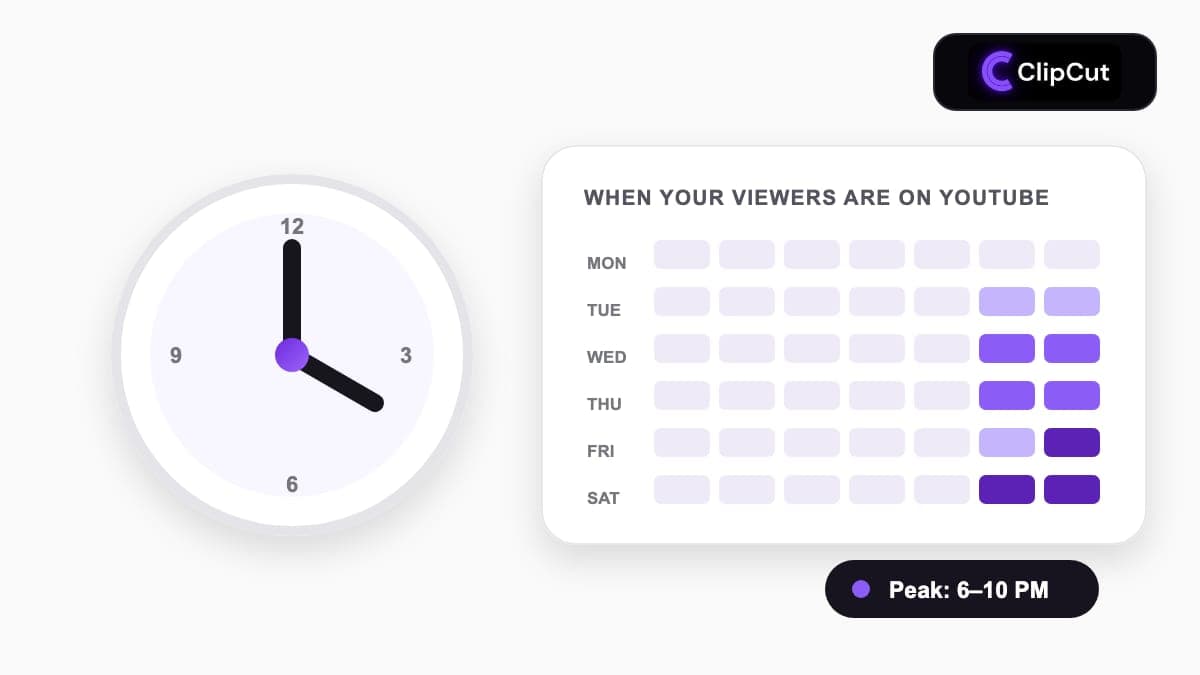
- Find the card titled "When your viewers are on YouTube."
- Read the grid. Each block is a day-and-hour slot, and the darker the block, the more of your viewers are active then, measured over the last 28 days.
The trick most people miss: do not post at the peak. Post one to two hours before it. You want your Short already live, indexed, and gathering its first few signals so that when your audience floods in during the peak, it is ready to ride the wave rather than starting cold. Publishing right at the peak means you spend the most valuable minutes still uploading and processing.
New channel showing "Not enough data to show this report"? That is normal below a certain view threshold. Until it fills in, use the day grid above, pick one consistent slot, and post daily for two to three weeks. The report will populate, and then you switch to your own numbers.
A posting cadence that actually compounds
Once you have a window, the game becomes consistency. The algorithm and your audience both reward a channel they can predict. Here is a cadence that works without burning you out:
1. Pick one fixed slot and defend it
Choose a single window from your Studio data and post there every day, or on the same three to five days each week. A fixed slot builds a habit for regular viewers who start expecting you, and it gives you a clean baseline to measure against. If everything is a moving target, you can never tell whether a change in views came from timing, content, or luck.
2. Protect quality over volume
One Short with a sharp hook and a satisfying loop will out-earn five rushed clips. Because Shorts keep resurfacing, a single strong video can carry your channel for weeks while weak ones simply sink. Do not sacrifice the hook to hit a daily number. If you are not sure what separates a strong Short from a forgettable one, our walkthrough on how to make YouTube Shorts covers format, length, and captions from scratch.
3. Batch so consistency is realistic
The reason most creators cannot keep a schedule is production time, not ideas. The fix is to stop making Shorts one at a time. If you already publish long-form videos, podcasts, or streams, a single upload can yield five to ten Shorts. This is exactly where a tool like ClipCut pays for itself: paste a video URL or upload a file, and the AI scans the whole thing for hooks and emotional peaks, cuts finished vertical clips, reframes them to 9:16 with subject tracking, and adds word-by-word captions that read on mute. You get a week of Shorts from one recording, which makes a daily cadence actually sustainable. Creators repurposing long content this way can see the full workflow on our page for creators.
4. Review every two weeks, then adjust
Every couple of weeks, reopen the Audience report and your top Shorts. Have your peak windows shifted? Did a particular slot outperform? Move your posting time toward what your own data shows and away from the generic chart. This loop, post consistently, measure, nudge, is what separates channels that grow from channels that guess.
The honest bottom line
"Best time to post" is a starting point, not a growth hack. The published windows, Tuesday through Thursday, midday and evening, are a reasonable default when you have nothing else to go on. But the moment your channel has data, your own "When your viewers are on YouTube" report beats every chart on the internet, including this one.
And even a perfect posting time cannot rescue a weak Short. Timing decides who sees your first hour. Your hook, retention, and loop decide what happens after. Get the content right, post when your people are online, stay consistent, and let the algorithm do the rest over the following weeks.
FAQ
What is the best time to post YouTube Shorts?
Across studies of millions of videos, the strongest general windows are weekday midday (roughly 11 AM to 3 PM) and evening (roughly 6 PM to 10 PM) in your audience's local time zone. Tuesday, Wednesday and Thursday are the top days, with Wednesday and Thursday around 4 PM standing out. These are averages, so treat them as a starting point and confirm against your own YouTube Studio data.
What is the best day to post YouTube Shorts?
Tuesday, Wednesday and Thursday consistently top the aggregated data. Buffer's analysis of 1.8 million videos flagged Wednesday at 4 PM as the strongest single Shorts slot, with Thursday and Monday at 4 PM close behind. Weekends still work if your audience is active then, especially mornings from 9 AM to 12 PM.
Does posting time actually matter for YouTube Shorts?
Less than it does for feed-based platforms. Shorts are distributed mostly through the algorithmic feed over days and weeks, not a chronological timeline, so a strong Short keeps getting served long after you post. Timing mainly helps the first hour by ensuring your core audience is online to engage quickly. Retention and hook strength matter far more than the exact minute.
How do I find the best time to post for my own channel?
Open YouTube Studio, go to the Audience tab, and find the card titled "When your viewers are on YouTube." It shows the last 28 days of viewer activity as blocks, with the darkest blocks being your peak windows. Publish one to two hours before those peaks so your Short is already live when your audience arrives.
How often should I post YouTube Shorts?
Consistency beats frequency. One well-made Short per day, or a reliable three to five per week at a fixed time, trains both your audience and your habit. Five weak clips will not outperform one strong one, so protect quality first and scale volume only once your workflow is fast enough to keep quality high. Batching Shorts from long videos is the usual way creators hit a daily cadence without burning out. You can compare plans and credit limits on the ClipCut pricing page.
Turn one long video into a week of Shorts
ClipCut scans your podcast, stream, or upload, finds the best moments, and cuts finished vertical clips with captions. Post daily without editing for hours. Free plan available, no card required.
Start Clipping Free